
Why Is My Flat Roof Leaking?
A Commercial Building Owner's Guide to Finding the Problem
If you manage or own a commercial building, school, church, or apartment complex in the Spokane, Coeur d'Alene, Seattle, Tacoma, Olympia, Vancouver areas, a leaking flat roof is one of the more expensive surprises a building can hand you. The problem is rarely where it looks like it is, and the fix is never as simple as patching the wet spot on the ceiling.
This guide covers why flat roofs leak, where the problems actually start, howto tell if moisture is hiding in your roof system before it becomes a full-blown leak, and why the Pacific Northwest rainy season makes early detection more important here than almost anywhere else.

Flat Roofs Are Not Actually Flat: Why Drainage Is Everything
The name is misleading. Commercial flat roofs are designed with a slight slope, typically a quarter inch of drop per foot, to move water toward drains, scuppers, or gutters. When that drainage system works, the roof performs well. When it does not, water sits. And sitting water is where most flat roof problems begin.
Think of it like a kitchen sink. The drain works fine until someone leaves a sponge over it. The sink is designed to drain, but the obstruction defeats the design. A flat roof works the same way: when the path to the drain gets blocked, or when the slope has been compromised by structural deflection or poor installation, water has nowhere to go.
The 10 Most Common Causes of Commercial Flat Roof Leaks

Figure 1. Common conditions that contribute to commercial flat roof leaks. This illustration is intended to help explain typical failure mechanisms encountered during roof inspections.
1. Ponding Water
Ponding is defined as water that remains on a roof surface for more than 48 hours after rain stops. That is the threshold established by the National Roofing Contractors Association (NRCA) and referenced in ASTM standards. Water that sits longer than that is not just a drainage inconvenience: it is actively damaging your roof.

Here is what prolonged ponding does:
-
Adds structural load. Water weighs approximately 5 pounds per square foot per inch of depth. A large puddle on a weakened deck can accelerate structural deflection, which creates a deeper low spot, which holds more water. Engineers call this ponding instability: it’s a self-reinforcing cycle.
-
Degrades the membrane. UV rays are magnified through standing water, accelerating breakdown of roofing materials. Algae and organic debris accumulate in ponding areas and attack the membrane surface.
-
Voids your warranty. Most commercial roofing warranties require water to drainwithin48 hours. If yours does not, coverage may be voided.
-
Freezes and expands. In the Spokane, Coeur d'Alene and the Eastern Washington climate, ponding water that freezes and thaws repeatedly can physically scrub and crack roof membranes.
Ponding happens because of inadequate slope, clogged drains, structural sagging, or compressed insulation that has created low spots over time.
2. A Damaged Roofing Membrane
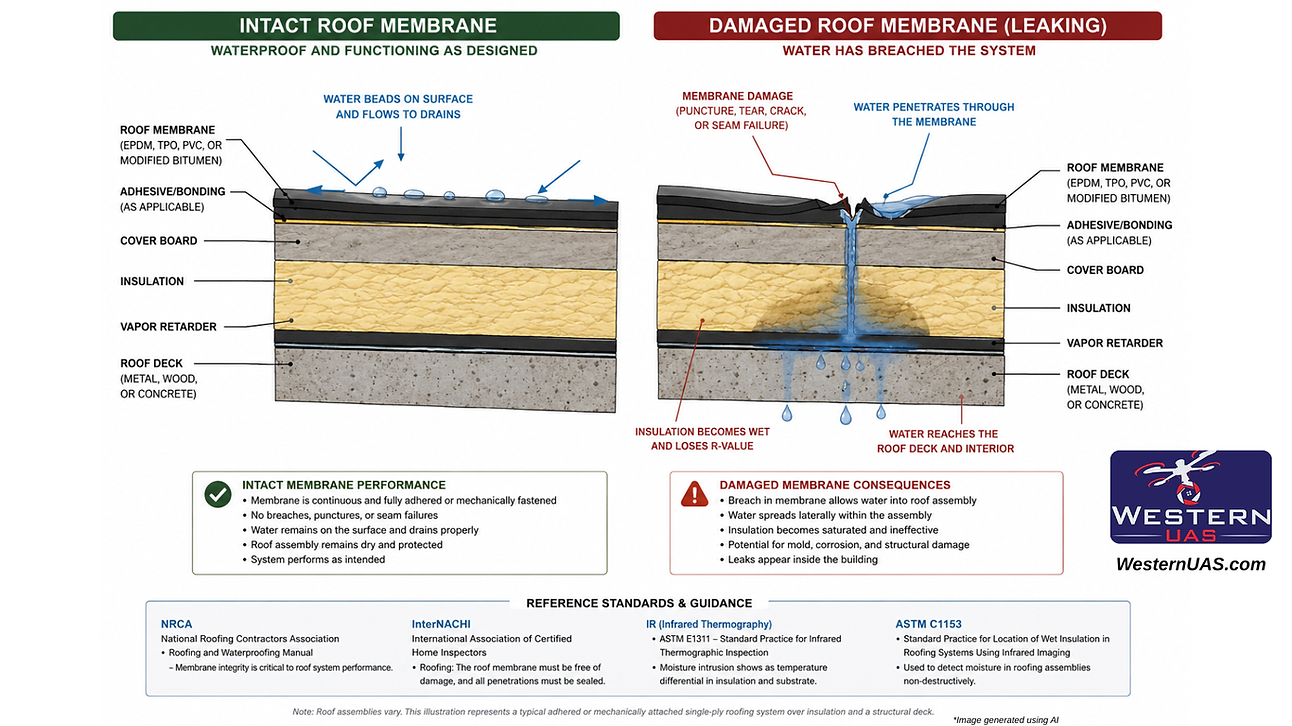
Most commercial flat roofs use one of three single-ply membrane systems:
-
EPDM (ethylene propylene diene monomer): A synthetic rubber membrane that has been the commercial roofing standard since the 1960s. Lifespan of 25 to 30-plus years with proper maintenance. Vulnerable at seams, which are typically bonded with adhesive rather than heat-welded.
-
TPO (thermoplastic polyolefin): Currently the most widely installed commercial membrane. Heat-welded seams are stronger than EPDM adhesive seams. Typical lifespan of 15 to 25 years.
-
PVC (polyvinyl chloride): A premium membrane with heat-welded seams and excellent chemical resistance. Best suited for buildings with rooftop exhaust systems or food service equipment. Lifespan of 20 to 30-plus years.
-
The fourth fairly common roofing material is BUR (Built Up Roofing) or Modified Bitumen. This type is made up of several layers and makes up about 20% of roofs.
When any of these membranes is punctured, cracked, blistered, or separated at a seam, water enters the roof system.
The tricky part: it rarely shows up directly below the entry point. Water migrates horizontally through insulation before it finds a path down. A ceiling stain in one corner of your building may be fed by a membrane breach twenty feet away.
3. Failed Seams
Every flat roof membrane is installed in sections. Those sections are joined at seams, and seams are the most statistically common source of flat roof leaks. This is especially true for EPDM roofs, where seams are bonded with tape or adhesive that degrades over time. TPO and PVC seams are heat-welded, which is more durable but still susceptible to failure from improper installation or building movement.
Seam failures are often invisible from the surface. The membrane may look fine while the bond underneath has failed completely. This is one of the primary reasons visual inspection misses what thermal imaging catches, and it's worth understanding what a failed seam actually looks like before assuming a leak is coming from somewhere else.

4. Flashing Failures
Flashing is the metal or membrane material that seals the transitions between the roof surface and anything that penetrates or edges it: walls, parapet caps, vents, skylights, drains, HVAC curbs, pipes. On a flat roof, these transition points are especially vulnerable because water sits close to them longer than it would on a pitched roof.
Common flashing failure points include:
-
Parapet walls, where the roof membrane terminates into vertical masonry - Pipe penetrations, where old caulk has cracked or separated - HVAC curbs, where vibration from equipment gradually loosens seals - Roof edge termination bars, which hold the membrane edge in place and can corrode or detach
-
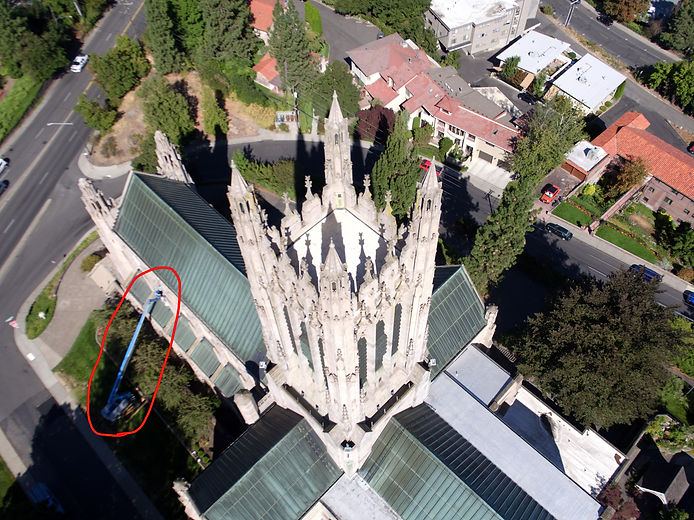
The Cathedral of St. John the Evangelist in Spokane is a good example. When Western UAS was called to inspect 1,232 linear feet of flashing and gutters on the building's historic Gothic exterior, the inspection would have required a 200-foot man-lift and four days of labor under traditional methods. A drone completed the full perimeter inspection in four hours, with the contractor's team watching live and directing attention to specific areas of concern.
5. Roof Penetrations and Equipment Curbs
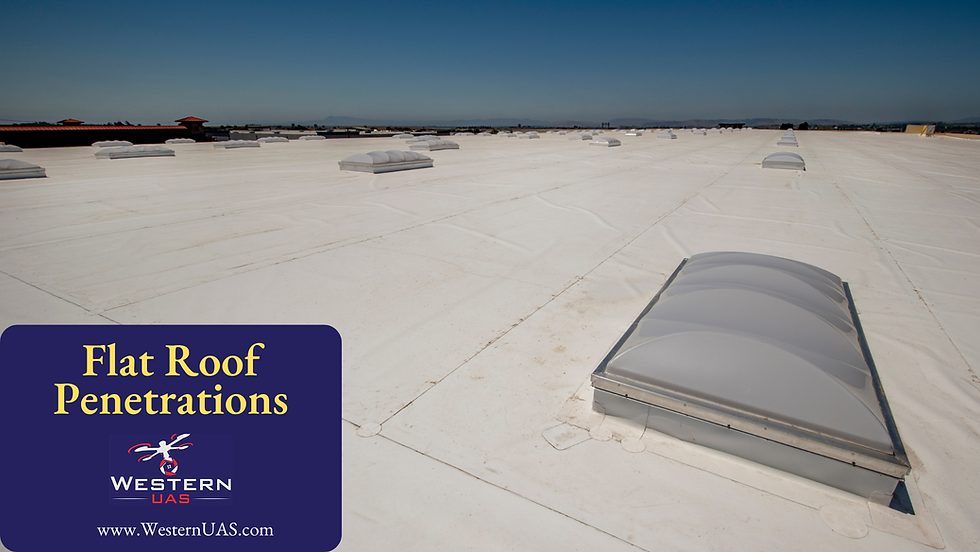
Every piece of equipment on a flat roof is a potential leak point: HVAC units, exhaust fans, skylights, pipes, antennas, satellite dishes, electrical conduit. The more equipment, the more penetrations, the more opportunities for water to find a gap.
Equipment also vibrates. Over time, vibration works seals and fasteners loose in ways that a seasonal visual inspection will miss entirely.
6. Clogged Drains, Scuppers, and Gutters
Flat roofs depend completely on a working drainage system. When drains clog with leaves, gravel, dirt, or debris, water backs up. This is one of the most preventable causes of flat roof damage, and one of the most common.
In the Pacific Northwest, where fall brings heavy leaf drop immediately before the rainy season begins, a clogged drain can turn a routine storm into a serious water event overnight.

7. Poor Original Installation
A flat roof can be installed with the wrong materials, wrong adhesive, insufficient slope, or inadequate seam welding, and the building owner has no way to know it until problems appear months or years later. Industry data from Monroe Infrared suggests that roughly one-third of all new commercial roofs will develop leaks before the end of the first year, and nearly 90 percent will show problems within five years if installation, design, or maintenance falls short.
If your building has a newer roof and is still leaking, installation quality is a serious consideration. Remember that most contractors provide a 2 year warranty on labor even if the material manufacturer provides a 15 or 20 year materials warranty.
8. UV and Weather Damage
Flat roof membranes take constant punishment from the elements. In Eastern Washington and North Idaho, that means wide temperature swings, significant UV exposure in summer, and freeze-thaw cycles in winter. Over time, membranes crack, dry out, shrink, and lose flexibility. This process accelerates on roofs that have not received regular maintenance.
9. Foot Traffic Damage
Commercial flat roofs are regularly accessed by HVAC technicians, telecommunications crews, solar installers, and maintenance staff. Without proper walk pads, foot traffic punctures and abrades membranes in ways that are small enough to be invisible from the ground but significant enough to let water in.
10. Condensation Mimicking a Leak
Not every interior water stain comes from a roof breach. In buildings with high interior humidity, poor ventilation, or insufficient insulation, condensation can form on cold roof deck surfaces and drip into the building in ways that look exactly like a roof leak. HVAC system issues can also generate moisture that appears to be coming from above.
This is worth ruling out before authorizing a roofing repair. A thermal inspection distinguishes between moisture trapped in the roof assembly and condensation or mechanical moisture sources.

Why the Leak You See Inside Is Rarely Where Water Is Getting In
Water is patient and indirect. It enters a roof system at one point, migrates horizontally through wet insulation, follows the path of least resistance through the roof assembly, and eventually finds its way through the ceiling somewhere else entirely.
This is the central diagnostic challenge with flat roofs. A contractor who climbs up and patches the area directly above the ceiling stain is guessing. They may guess correctly. But when they do not, the building owner pays for a repair that does not fix the problem, the ceiling stains again after the next rain, and the underlying moisture continues spreading through the insulation.
The only reliable way to find where water is actually entering a roof system, and how far it has spread through the insulation below the surface, is thermal imaging.
How Drone Thermal Imaging Finds Flat Roof Leaks (And Why It Has to Happen After Dark)
Thermal infrared imaging works by detecting temperature differences on the roof surface that the naked eye cannot see. Here is the physics behind it.
During the day, the sun heats the entire roof surface, including the insulation beneath it. Dry insulation absorbs and releases heat at a predictable rate. Wet insulation holds heat longer because water has significantly higher thermal mass than air. After sunset, as the roof cools, the wet areas release their stored heat more slowly than the surrounding dry areas. From above, a calibrated thermal imager sees those wet zones glowing warmer against the cooling background.
The temperature difference between wet and dry insulation is often only two to four degrees Fahrenheit. A standard construction camera would miss it entirely. A calibrated thermal imager in the hands of a certified thermographer reads it clearly.
This is why thermal roof inspections are conducted after sunset, and why certification matters. The imaging window is relatively short: the roof needs to have cooled enough for contrast to develop, but not so cold that everything equalizes. Knowing how to read what the imager shows, distinguishing wet insulation from HVAC heat signatures, reflective materials, roof debris or drain warmth, requires training and field experience.
Western UAS conducts all thermal roof inspections after sunset using drone-mounted FLIR thermal imagers. The drone can cover 400,000 to 500,000 square feet per hour, produces high-resolution imagery of the entire roof surface, and reaches areas that would be inaccessible or dangerous for a person to inspect on foot. There's a longer case for why drone thermal inspection outperforms a walked inspection on speed, safety, and data quality, beyond just the headline numbers. The school inspection in Spokane Valley, for example, covered a large multi-section roof from 195 feet up and identified significant deferred maintenance that was not visible from the ground.
After the inspection, every client receives a written report with both standard and thermal images documenting the location and extent of any moisture-affected areas.
Where Commercial Flat Roof Leaks Most Often Start
If you are doing a visual check before scheduling a professional inspection, focus on these areas first:
-
Around roof drains, where debris accumulates and water sits longest - At seams, especially on older EPDM roofs
-
Around parapet walls and the flashing where the membrane terminates - At HVAC curbs and equipment bases
-
Around any pipe or vent penetration
-
At roof edges and termination details
-
Near skylights
-
At expansion joints on large roofs
-
These are not the only places leaks start, but they are the most statistically common.
The Best Time to Schedule a Commercial Roof Inspection in Spokane, Coeur d'Alene and the Pacific Northwest
The Spokane and Coeur d'Alene region has a distinct seasonal pattern that makes timing matter more than it does in drier climates.
Late summer and early fall (August through September) is the most valuable window for a commercial roof inspection. Here is why:
The roof has just completed a full season of UV exposure and summer temperature extremes, which is when membrane cracking, seam stress, and flashing degradation are most visible. Drainage systems have had a full year to accumulate debris. And critically, the rainy season has not yet started. Any problems found in August or September can be repaired before the months of continuous rainfall that characterize October through March in Eastern Washington and North Idaho.
A roof that enters the rainy season with compromised seams, blocked drains, or damaged flashing will not be the same roof by spring. Water that sits in wet insulation through a Pacific Northwest winter accelerates deterioration, adds structural load with freeze-thaw cycling, and can turn a $2,000 repair into a full replacement conversation.
Spring (April through May) is the second best window: post-winter damage assessment before the building heads into another summer. A spring inspection tells you what the winter found and what needs attention before the next heating and cooling cycle begins.
Industry guidance from the NRCA recommends commercial flat roofs be inspected at least twice per year, with additional inspections after major weather events. For most commercial buildings in this region, late summer and spring are the two right moments.
What Building Owners and Facility Managers Should Do If You Have an Active Leak:
-
Document everything: photograph interior damage, the exterior roof surface near the suspected entry point, and any drainage issues. Note when the leak appears relative to rain events.
-
Protect inventory, equipment, and finishes from ongoing water contact.
-
Schedule a thermal inspection rather than a visual-only assessment. You need to know where the water is coming from and how far it has spread through the insulation, not just where the ceiling is wet.
If you do not have an active leak but have not inspected recently:
The absence of a visible leak does not mean the roof is dry. Moisture can accumulate in flat roof insulation for months before it finds a path through the deck and ceiling. By the time it drips, significant insulation damage has already occurred. A thermal inspection during the late summer window gives you an accurate picture of what is actually in the roof before the rainy season confirms it the hard way.
Routine maintenance between inspections:
-
Clear drains, scuppers, and gutters before the fall rainy season and after any major storm
-
Walk the roof after significant weather events and look for obvious standing water, displaced materials, or debris accumulation near drains
-
Keep a record of any rooftop equipment service visits and confirm that penetrations are re-sealed after work is completed
-
If crews access the roof, verify that walk pads are in place and being used
Why Western UAS Only Inspects and Why That Matters to You
Western UAS is not a roofing contractor. We do not repair or replace roofs. We inspect them.
(We are not here to make a high-pressure sales pitch for a new roof.)
That distinction matters because a company that profits from the repairs it recommends has a different incentive structure than one that profits only from accurate inspection. When the inspector is the contractor, there is an inherent pressure to find problems worth fixing. When the inspector has no financial stake in what you decide to do after receiving the report, you get an accurate picture.
Tom Ethen of Western UAS holds an ITC Level 1 Thermographer certification with more than 8 years of drone-based thermal inspection experience. He works in close partnership with Brent Foster of CDA Building Infrared, a Level III Thermographer and BPI Building Analyst with13 years of building inspection experience. Together, they provide two credentialed specialists for complex diagnostic questions when a single inspection requires multiple perspectives.
The report you receive after a Western UAS inspection documents exactly what is in the roof, where it is, and how extensive it is. What you do with that information is your decision.

Frequently Asked Questions
How do I know if my flat roof has a leak before water shows up inside?
You often cannot tell from inside the building. By the time water drips through a ceiling, moisture has typically been accumulating in the roof insulation for weeks or months. The only reliable early-detection method is thermal imaging, which identifies wet insulation before it becomes a visible leak.
What is ponding water and why does it matter?
Ponding water is any water that remains on a flat roof surface more than 48 hours after rain stops, per NRCA standards. It matters because it degrades roofing materials, adds structural load, voids most manufacturer warranties, and creates conditions for algae and organic growth that attack the membrane. In freezing climates like Eastern Washington and North Idaho, repeated freeze-thaw cycles in ponding areas cause additional physical damage to the membrane and insulation.
Why does thermal inspection have to happen after dark?
The physics require it. During the day, the entire roof surface is warm from solar heating, which masks the temperature difference between wet and dry insulation. After sunset, the roof cools. Dry insulation cools quickly; wet insulation holds heat longer because water has high thermal mass. That contrast is what the thermal imager reads. Without the temperature differential that develops after cooling begins, there is nothing for the camera to detect.
Can thermal imaging inspect any flat roof?
Most commercial flat roofs with insulation sandwiched between the deck and the waterproofing membrane are good candidates for thermal inspection. Systems that are less suitable include inverted or protected membrane assemblies (where insulation sits on top of the membrane rather than beneath it) and some concrete deck systems with entrained moisture. A pre-inspection consultation confirms whether your roof system is appropriate for thermal imaging before the scan is scheduled.
How much can a missed roof leak actually cost?
The cost depends on how long it goes undetected. Wet insulation that is caught early can sometimes be dried and the membrane repaired locally, which is a repair in the thousands of dollars. The same moisture left for a full Pacific Northwest rainy season may compromise the roof deck, require full insulation replacement, and trigger the International Energy Conservation Code's insulation requirements that apply to roof replacements but not repairs. Full commercial roof replacement runs $8 to $35 or more per square foot depending on the system and roof complexity. A 20,000-square-foot commercial roof represents a significant capital expense that a timely inspection and modest repair can defer for years.
Do you serve Coeur d'Alene, Spokane and Eastern Washington?
Yes. Western UAS serves commercial building owners, property managers, school districts, religious institutions, and facility managers throughout the Spokane and Coeur d'Alene metro areas and across Washington, Oregon, Idaho, Montana, Nevada, and Northern California.
Ready to Find Out What Is Actually in Your Roof?
A Western UAS thermal inspection gives you an accurate, documented picture of your roof's moisture condition, not a guess based on where the ceiling is wet. We cover up to 400,000 to 500,000 square feet per hour by drone, reach areas inaccessible to foot inspection, and deliver a report with standard and thermal images within two days.
Call Tom at (509) 638-7198 or email to schedule an inspection or ask about your specific roof system.
The best time to find a flat roof problem is before the rain does it for you.
We inspect roofs. That's it. No repairs, no replacements, no pressure to buy anything. You get an honest report and you decide what to do with it.