
The Advantages of a Drone Thermal Inspection for Flat and Low-Slope Roofs
Quick answer: A drone thermal inspection scans an entire flat roof for hidden moisture, heat loss, and insulation failure in minutes instead of hours, without anyone walking the roof surface. It finds problems before they show up as a ceiling stain, and it does it safely, at a fraction of the time a manual walk-through takes.

Flat roofs are efficient. They're also good at hiding problems. Moisture intrusion, insulation failure, and heat loss typically develop well before there's a visible sign inside the building. By the time a ceiling stain shows up, the water has usually been there for months. Understanding why flat roofs develop leaks in the first place makes it clear why catching the problem early matters this much.
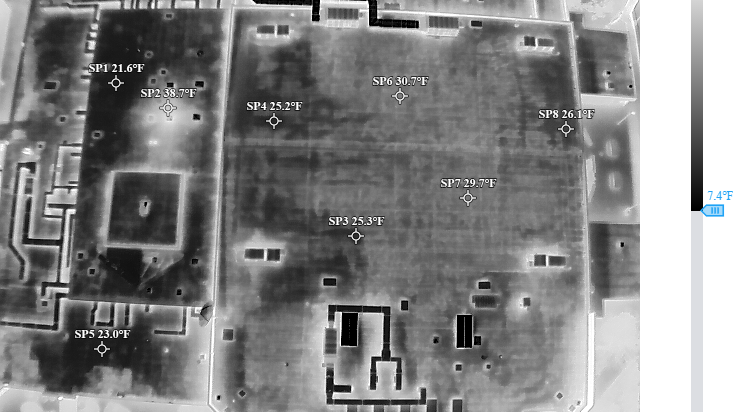
A drone thermal inspection closes that gap. It pairs aerial imaging with a thermal camera to scan the full roof surface and map temperature differences across it. Wet insulation holds and releases heat differently than dry insulation, so it shows up clearly on a thermal scan under the right conditions. That difference is what makes a roof's hidden problems visible before they become expensive ones.
Here's what that actually gets a building owner.
1. Finds Moisture You Can't See From the Inside
Wet insulation changes temperature at a different rate than dry insulation, which makes it visible on a thermal scan. For flat roofs specifically, this matters because water doesn't always drip straight down. It travels laterally under the membrane before it ever shows up as an interior leak, so the wet spot on the ceiling is often nowhere near the source of the problem on the roof.
Why it matters:
-
Moisture spreads before any visible leak appears
-
Wet insulation loses R-value and roof performance
-
Trapped water leads to mold, rot, and structural damage over time. Seams are one of the most common points where a membrane actually fails, and trapped water at a failed seam leads to mold, rot, and structural damage over time.
-
Catching it early is a fraction of the cost of catching it late
2. Safer Than Walking the Roof
Flat roofs aren't automatically safe just because they're flat. Fragile membranes, wet surfaces, height, and equipment clutter all add risk for anyone walking the surface. Roofing consistently ranks among the most dangerous trades in the country: roofers had a fatal injury rate of 48.7 per 100,000 full-time workers in 2024, nearly 15 times the rate for all occupations combined (U.S. Bureau of Labor Statistics, 2024). Falls account for the large majority of those deaths.
A drone inspection means nobody has to step onto the roof to get a full picture of its condition.
A drone inspection removes that exposure entirely for large or hard-to-access roofs, without sacrificing the data a walked inspection is meant to produce. At the Cathedral of St. John the Evangelist, a 1,232-foot flashing and gutter inspection that would have required a 200-foot man-lift and four days of labor was completed by drone in four hours.
3. Covers Large Roofs Fast
A manually walked roof inspection typically covers approximately 10,000 to 20,000 square feet per hour. On a 100,000 square foot roof, that's the better part of a full night on foot in the dark, since thermal inspections are done after sunset to capture the diurnal temperature swing.
Timing matters here for a reason beyond convenience. Wet insulation tends to reach thermal equilibrium with the surrounding dry areas within five to six hours, so the inspection window is real and it's short. A drone inspection covers the same roof in a fraction of that time, which means more of the roof gets scanned inside the window where the temperature contrast is still useful data instead of a faded signal.
That speed is what let a Western UAS inspection cover the multi-section roof at a Spokane Valley High School and surface deferred maintenance that wasn't visible from the ground.
Warmer zones on the thermal map correspond to areas most likely holding moisture beneath the membrane.

4. Helps Prioritize Repairs
Not every flagged area needs immediate replacement. Thermal imaging helps building owners and roofing contractors see not just where a problem exists, but how serious it is relative to the rest of the roof. That distinction is what turns a vague "the roof needs work" into an actual budget and repair sequence.
5. Reduces Unnecessary Roof Disturbance
Confirming suspected damage sometimes means cutting into the roof to check. A thermal scan narrows down the likely problem areas first, which cuts down on how much invasive investigation is actually needed. That matters most on older roofs and roofs still under warranty, where unnecessary cuts can create new problems or void coverage.
6. Useful After Storms
After hail, wind, heavy rain, or a sharp temperature swing, a thermal inspection can catch damage that isn't visible from the ground or even from a quick walk of the roof. It can reveal membrane separation, new moisture intrusion, heat anomalies from compromised insulation, and areas affected by storm-related movement, giving a building owner a fast, objective answer on whether a full inspection is warranted.
7. Creates Real Documentation
Thermal images and aerial photos build a record of how a roof's condition changes over time, which is a lot more reliable than relying on memory or informal notes. That record supports maintenance logs, capital planning, insurance claims, and warranty documentation, and it makes year-over-year comparisons possible instead of anecdotal.
8. Supports Energy Assessments
A flat roof with wet insulation or thermal defects doesn't perform the way it should from an energy standpoint. Thermal imaging can identify insulation voids and heat loss areas that are actively costing a building money on utilities, which is useful data for any facility where energy costs are part of the budget conversation.
9. Built for Hard-to-Access Roofs
Drone thermal inspection works best on flat or low-slope roofs where a broad overview is needed before any hands-on investigation happens. It's especially useful for large buildings, roofs with a history of leaks, and roofs that are simply difficult or dangerous to reach by other means.
Is a Drone Thermal Inspection Right for Your Roof?
A drone thermal inspection finds hidden moisture, supports early leak detection, improves safety, covers large areas fast, helps prioritize repairs, reduces unnecessary roof disturbance, documents roof condition over time, and can surface energy-related issues, all without anyone walking the roof.
For building owners, it's one of the most efficient ways to actually know a roof's condition instead of guessing, climbing blind, or waiting for the ceiling to tell them.
Western UAS provides drone aerial thermal roof inspections for commercial buildings across the Pacific Northwest. Inspection-only, FAA licensed, ITC Level 1 Certified.
