
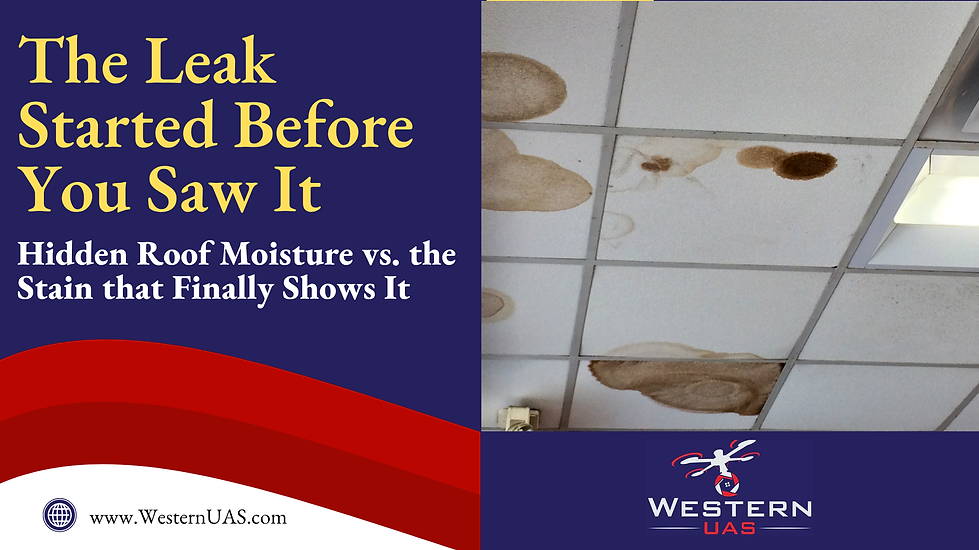
Signs Your Commercial Roof Has Hidden Water Damage
Quick answer: The most serious moisture problems on a commercial roof rarely show up as an obvious leak first. Ceiling stains, musty odors, rising energy costs, and recurring leaks in the same spot are all signals that water has been active in the roof assembly for a while, often well before it becomes visible inside the building. A drone thermal inspection can identify hidden moisture and damaged roof components before the problem gets more expensive to fix.

Water damage is one of the most costly problems a commercial building owner can face, and some of the most serious moisture issues aren't visible from the ground. A roof can develop damaged membranes, failing flashing, and drainage problems long before water starts dripping from the ceiling. By the time an interior leak becomes obvious, moisture may already have spread through insulation, decking, or interior finishes.
That's why early detection matters more than most building owners realize. Here are the warning signs worth watching for, and how a drone inspection helps confirm what's actually happening on the roof.
1. Water Stains on Ceilings or Walls
Brown, yellow, or dark stains on ceilings and upper walls are the most obvious sign that moisture is somewhere it shouldn't be. The hard part is figuring out where it's actually coming from.
Water travels along roof decking, insulation, and structural components before it becomes visible inside the building, which means the stain rarely sits directly below the actual roof defect. This is the same diagnostic challenge covered in why flat roofs leak in the first place: a contractor who patches the area above the stain is guessing, and sometimes guessing wrong.

A drone inspection can document the roof surface above and around the affected area, identifying damaged membranes, flashing issues, open seams, or drainage problems that a ground-level view would miss entirely.
2. Ponding Water on Flat or Low-Slope Roofs
Standing water that remains more than 48 hours after rain stops, per NRCA guidance, is one of the clearest warning signs a commercial roof is giving. Persistent ponding stresses seams, flashing, and other vulnerable components, and it often points to clogged drains, inadequate slope, or a low spot that's developed over time. Ponding water deserves its own closer look, since it's frequently the earliest visible sign that something underneath the surface has already changed.
High-resolution aerial imagery gives a broader view of drainage patterns than a limited rooftop walk-through can, and it makes it possible to track whether a problem area is getting worse over time.


3. Damaged Membranes, Seams, and Flashing
Commercial roofs have numerous points where water can get in: membrane seams, flashing, parapet walls, roof edges, HVAC curbs, plumbing vents, skylights, and other penetrations. A small defect at any one of these points can lead to a large problem.
Seam failures in particular are often invisible from the surface. The membrane can look intact while the bond underneath has already separated. Failed seams are worth understanding in more detail since they're one of the most common and least visible sources of a flat roof leak.
Drone imagery documents these areas systematically across a large roof, without relying only on what's visible from ground level or a single walked path.
4. Musty Odors or Unexplained Interior Moisture
An unexplained musty smell near the upper floors of a building can indicate moisture somewhere in the building envelope. It doesn't automatically mean the roof is the source. Plumbing, HVAC condensation, and other building systems can produce the same symptom.
When interior moisture shows up without an obvious cause, the roof is worth investigating as a potential source. Drone imagery of the exterior roof conditions above the affected interior area helps determine whether a closer, hands-on investigation is warranted.
5. Unexplained Changes in Energy Costs
Wet insulation loses effectiveness, which can drive up heating and cooling demand. A rising utility bill by itself doesn't prove roof moisture, since energy costs fluctuate for plenty of reasons. But when higher energy use shows up alongside other signs on this list, it's worth investigating further.
This is one place a thermal drone inspection adds real value. Under the right conditions, thermal imaging reveals temperature differences across a roof surface that can be consistent with trapped moisture beneath the membrane.
6. Recurring Roof Leaks
A leak that returns in the same spot every time it rains hard usually means a previous repair addressed the symptom, not the actual source. Aerial imagery documents the larger roof area around the suspected leak rather than just the spot directly above the interior stain, which is how a recurring leak actually gets resolved instead of patched again.
7. Roof Areas That Are Difficult or Risky to Access
Large warehouses, multi-story buildings, and roofs with heavy equipment clutter all complicate a traditional visual inspection. A drone documents these areas in detail without putting anyone on a roof that's genuinely difficult or dangerous to walk. It doesn't remove the need for a qualified roofing professional when physical testing or repair is required, but it identifies and prioritizes where that closer look actually needs to happen.
How Thermal Imaging Adds a Layer Standard Photography Can't
Standard drone photography documents visible roof conditions clearly. Thermal imaging adds a different kind of information entirely. Different roof areas heat and cool at different rates, and under suitable conditions, an infrared camera captures those temperature variations. Moisture beneath certain roofing systems creates thermal patterns that stand out from the surrounding dry areas.
That said, thermal imaging doesn't let an inspector see water through the roof. It detects temperature differences that suggest where further investigation is warranted. Those findings still need to be verified through appropriate methods, moisture meters, test cuts, or core samples, by a qualified roofing professional.
Drone Inspection and Traditional Inspection Aren't Competing Methods
A drone inspection doesn't replace a roofer walking the roof when physical work is needed. The two serve different stages of the same process. A drone survey covers the full roof, identifies the areas that look suspect, and narrows down where attention actually belongs. A qualified roofer or building-envelope professional then investigates those specific locations, takes moisture readings, or performs the repair. That sequence, survey the roof, identify likely problem areas, investigate those locations, then make a repair decision, is a more efficient use of everyone's time than treating every square foot of a large commercial roof the same way. It's also why a drone inspection report is useful even when it doesn't turn up an obvious defect: it tells you where to keep watching.
When to Schedule a Drone Roof Inspection
A drone inspection is worth scheduling if you've discovered an interior leak, noticed water stains, experienced severe weather, are concerned about ponding, deal with recurring leaks, manage a large or hard-to-access roof, or simply want baseline documentation before problems start.
You don't need to wait for a visible leak. Periodic aerial documentation builds a record of roof conditions over time, which makes it far easier to catch a change during a future inspection instead of discovering it after it's already inside the building. For owners or facility teams managing several buildings, consistent aerial documentation across a portfolio makes it possible to compare roof conditions property to property, not just track one roof over time.
Common Questions
Can a drone detect water damage in a commercial roof? A drone equipped with a thermal camera can detect surface temperature differences that may indicate trapped moisture. Thermal anomalies aren't definitive proof on their own and need to be verified through additional inspection or testing.
Are drone roof inspections useful for flat commercial roofs specifically? Yes. Large flat and low-slope roofs are particularly well suited to aerial inspection, since drones can efficiently document broad roof areas, drainage patterns, and rooftop equipment that would take far longer to cover on foot.
Does a drone inspection replace a commercial roofer? No. A drone inspection provides visual and thermal data that identifies and prioritizes where a problem likely exists. Physical inspection, moisture verification, and repairs still require a qualified roofing or building-envelope professional.
How often should a commercial roof get a drone inspection? It depends on the roof's age, system, and maintenance history, but a regular schedule builds the kind of condition history that makes changes easy to spot. Inspections are also valuable after major storms, before planned maintenance, and when investigating an active leak.

Don't Wait for Hidden Damage to Become an Expensive Surprise
The most visible roof problem isn't always the most serious one. Western UAS provides drone aerial and thermal roof inspections for commercial buildings across the Pacific Northwest, documenting exactly what's happening on the roof rather than guessing based on where the ceiling is wet. Tom Ethen is an ITC Level 1 Certified Thermographer and FAA Certified Drone Pilot with years of drone-based inspection experience.
Western UAS is inspection-only. No repairs, no replacements, no pressure to buy anything you don't need.
Call Tom at (509) 638-7198 to schedule an assessment before a small issue becomes a much larger one.

What an Infrared Camera Sees
An infrared camera detects thermal anomalies by imaging infrared energy emitted, reflected, or transmitted from surfaces. While it does not measure moisture content directly, it highlights areas of concern where further verification through moisture probes or intrusive test cuts may be necessary. This method ensures a thorough and accurate analysis of the building envelope.
The Value of a Skilled Thermographer
A skilled thermographer knows where to look and how to interpret infrared readings accurately. Proper verification techniques, such as moisture probes and other test methods, help minimize errors and ensure reliable results.
Old Moisture Intrusion Detection Methods
Traditional moisture meters required contact with surfaces every few inches, making the process time-consuming and expensive. Testing large buildings, like a 100,000-square-foot roof, could take days and cost tens of thousands of dollars.
The Benefits of Infrared Cameras
With infrared technology, you can identify the location of problem areas with high accuracy, taking the guesswork out of trying to find issues hidden within walls, ceilings, or roofs.
-
Faster Inspections: Infrared can scan large areas in hours rather than days.
-
Accurate Results: Pinpoint problem areas with high precision.
-
Non-Destructive Testing: No need to drill or damage surfaces to find moisture.
-
Cost-Effective: Reduces labor and time costs significantly.