
Commercial Flat Roof Fire Prevention: Why Embers, Not Flames, Destroy Buildings
Quick answer: Most buildings lost in wildfires don't ignite from direct flame contact. Wind-driven embers land in rooftop debris and account for up to 90 percent of structure ignitions during wildfires (Potter and Leonard, 2010; IBHS).

A drone inspection reveals what ground crews rarely see: pallets, fuel containers, and a season of dry leaves stacked directly against rooftop equipment.
That's not a hypothetical. It's a real roof, photographed during a Western UAS inspection. Every item in that photo is a documented ignition risk: dry leaf litter, wood pallets, plastic fuel containers, and cardboard, all sitting within a few feet of HVAC units with open intake vents. One wind-blown ember is the only thing missing.
This is the outcome that scenario is built for.
The Roof Is the Most Overlooked Wildfire Exposure on a Commercial Building
Property owners plan defensible space at ground level: clearing brush, trimming trees, spacing vegetation. That work matters, but it protects the perimeter, not the roof. On a commercial flat roof, the ignition risk is different in kind. It's horizontal, not vertical, and it's built up over months, not minutes.
Research from the Insurance Institute for Business & Home Safety (IBHS) and the U.S. Forest Service has consistently identified ember exposure, not the fire front itself, as the dominant ignition pathway. Analysis of the 2007 Witch Creek Fire in San Diego County found two of every three destroyed homes ignited from ember accumulation rather than direct flame contact. Flat commercial roofs are more exposed to this mechanism than sloped residential roofs because they collect and hold debris instead of shedding it.
.png)
What Accumulates on a Flat Roof That Nobody Sees
Commercial flat roofs collect a specific set of fuels most property managers never inspect directly, because doing so means walking the entire roof surface, often tens of thousands of square feet, on foot:
-
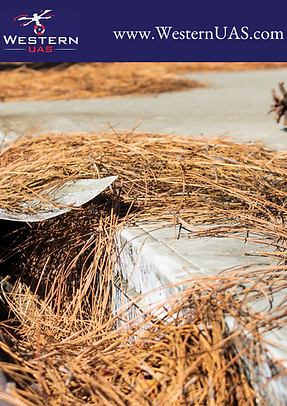
Leaves, pine needles, and seed pods in roof valleys and drain sumps
-
Bird nests and organic debris behind rooftop equipment
-
Cardboard, packaging, and trash left by maintenance crews
-
Wood pallets and lumber stored temporarily and forgotten
-
Fuel cans, solvent containers, and other combustibles staged near HVAC units
-
Dust and dry organic buildup under solar arrays, where airflow is restricted and debris doesn't blow off
None of this is visible from a parking lot or an adjacent building. It's usually not visible from a single ladder access point either, since large commercial roofs have multiple equipment zones, parapet sections, and blind spots created by HVAC curbs and mechanical screens.


Why Ground-Based Inspections Miss Fire Hazards
A property manager walking a 40,000 square foot roof once a year, if that, is not going to systematically check behind every HVAC unit, inside every drain sump, and underneath every solar panel. It's slow, it's a fall hazard, and it's easy to miss a debris pocket that's out of the direct walking path.
This is the gap drone thermal inspection is built to close. A drone covers the full roof surface in a single flight, capturing high-resolution imagery of every equipment zone, edge condition, and drainage point without anyone walking the membrane. Areas that would take a ground crew hours to check on foot, and that often get skipped because they're inconvenient to reach, get documented in minutes.
Thermal imaging adds a second layer specific to fire risk. After a fire event, thermal cameras can identify smoldering hot spots beneath debris or equipment that aren't visible to the naked eye, which matters because ember ignition doesn't always produce visible flame right away. Debris can smolder for hours before a fire becomes apparent at the surface.
Daylight Visual Inspection Matters Just as Much as Thermal
Fire risk assessment isn't a thermal problem in the way moisture detection is. Debris accumulation, staged fuel containers, damaged flashing, and combustible storage are visible conditions, not temperature signatures, which means they're best documented in daylight with high-resolution color imagery rather than waiting for the after-dark thermal window a moisture survey requires.
A live, color drone pass during daylight hours gives a building owner a clear, current record of exactly what's sitting on the roof: where debris has accumulated, what's staged near HVAC units, and which areas need attention before fire season, not after it. Thermal imaging still has a role after a fire event, when it can locate smoldering hot spots hidden beneath debris. But for identifying the fire risk itself, a daylight visual inspection is the primary tool.
.png)

What to Check Before Fire Season
Clear combustible debris on a schedule, not an emergency basis. Monthly during dry months is the standard IBHS and NFPA guidance point toward for high-risk periods. Pay specific attention to drain sumps, expansion joints, and the areas directly behind and beneath rooftop equipment.
Inspect and seal roof penetrations. Pipe boots, conduit penetrations, roof hatches, and skylight curbs are common ember entry points when flashing has degraded or sealant has failed.
Protect HVAC intakes. Ember-resistant intake screens and well-maintained gaskets reduce the chance of embers entering equipment directly. Some building automation systems can close outside air dampers automatically during smoke events.
Replace combustible equipment supports. Wood sleepers and untreated lumber under HVAC units and solar racking should be replaced with steel, aluminum, or concrete supports.
Eliminate rooftop storage entirely. Pallets, fuel containers, and construction materials should never be staged on a roof, in any season. This is the single most common finding on inspections like the one in the photo above.
Confirm the roof edge and coping are intact. Wind concentrates embers at roof edges. Loose edge metal, open seams, and missing fasteners create entry points exactly where ember exposure is highest.
Know your roof assembly's fire rating. When reroofing, Class A fire-rated assemblies and FM Approved systems provide a meaningfully higher level of protection than uprated field modifications after the fact. This is a conversation for your roofing contractor at time of replacement, not something an inspection alone can retrofit.

Frequently Asked Questions
How often should a commercial flat roof be inspected for fire risk? At minimum, before fire season begins and again after any major windstorm. Buildings in high wildfire-risk zones benefit from monthly debris checks during dry months, which is difficult to sustain with ground crews alone and is where a periodic drone inspection fills the gap efficiently.
Does rooftop debris actually increase insurance risk? Insurers increasingly factor wildfire mitigation into commercial property underwriting, and documented rooftop maintenance, including inspection records, supports that conversation. An inspection report is evidence of due diligence, not just a maintenance checklist.
Can a drone inspection replace a roofer walking the roof? No, and it isn't meant to. A drone thermal inspection identifies debris accumulation, ember traps, damaged flashing, and moisture intrusion across the full roof surface efficiently. Repairs and remediation still require a licensed roofing contractor. Western UAS is inspection-only: we document what's there so building owners and their roofing contractors know exactly where to focus.
The Bottom Line
Wildfire protection for a commercial building doesn't stop at the property line. The roof is where a season of overlooked debris and a single wind-blown ember can meet, often in places no one on the ground ever checks. A drone thermal inspection puts eyes on the entire roof surface, including the equipment zones and drain sumps that get skipped year after year, before that debris becomes the reason a building doesn't make it through fire season.
Western UAS provides drone aerial thermal roof inspections for commercial buildings across the Pacific Northwest. Inspection-only, FAA certified, ITC Level 1 Certified. If your roof hasn't been checked since last season, now is the time.
